 Add to Chrome
 Add to Firefox
 Add to Edge
LLaVA-OneVision-2: Towards Next-Generation Perceptual Intelligence
May 25, 2026
We introduce LLaVA-OneVision-2 (LLaVA-OV-2), the most capable vision-language model in the LLaVA-OneVision series to date, achieving superior performance across a broad range of multimodal benchmarks. The model builds on a native OneVision-Encoder and incorporates Windowed Attention for efficient local computation while maintaining native resolution. Its key advance is codec-stream tokenization: it treats compressed video as a continuous bit-cost stream, where bit-cost dynamics determine adaptive temporal groups, and motion-residual cues select salient spatial evidence into compact visual canvases. This allocation concentrates a limited token budget on event-bearing content, enabling more stable long-video token compression than fixed groups of pictures. A shared 3D RoPE further places codec canvases, sampled frames, and images in a unified spatiotemporal coordinate system. Furthermore, we build the LLaVA-OV-2 data and training stack around large-scale open supervision: approximately 8M re-captioned video samples for pretraining, a 4M-sample spatial corpus for fine-tuning. We also introduce JumpScore, a temporal-localization benchmark targeting fine-grained grounding in high-frequency, densely repeated motion, a regime underrepresented by existing video evaluations. A standout capability of LLaVA-OV-2 is its unified perception across video understanding, temporal grounding, spatial grounding, and manipulation-trace reasoning. On JumpScore, LLaVA-OneVision-2-8B reaches 74.9 JumpScore mAP, surpassing Qwen3-VL-8B (30.1) by +44.8 points; under matched visual-token budgets on the same benchmark, codec-stream inputs improve temporal grounding over frame sampling by +9.7 points. Across standard benchmarks, LLaVA-OneVision-2-8B further outperforms Qwen3-VL-8B by +4.3 average points on video tasks, +5.3 on spatial tasks, and +15.6 average J&F on tracking tasks.

LatentOmni: Rethinking Omni-Modal Understanding via Unified Audio-Visual Latent Reasoning
May 21, 2026Joint audio-visual reasoning is essential for omnimodal understanding, yet current multimodal large language models (MLLMs) still struggle when reasoning requires fine-grained evidence from both modalities. A central limitation is that explicit text-based chain-of-thought (CoT) compresses continuous audio-visual signals into discrete tokens, weakening temporal grounding and shifting intermediate reasoning toward language priors. We argue that a unified latent space is a better medium for such reasoning because it preserves dense sensory information while remaining compatible with autoregressive generation. Based on this insight, we propose \textbf{LatentOmni}, a cross-modal reasoning framework that interleaves textual reasoning with audio-visual latent states. LatentOmni introduces feature-level supervision to align latent reasoning states with task-relevant sensory features and uses Omni-Sync Position Embedding (OSPE) to maintain temporal consistency between latent audio and visual states. We further construct \textbf{LatentOmni-Instruct-35K}, a dataset of audio-visual interleaved reasoning trajectories for supervising latent-space reasoning. Comprehensive evaluation across multiple audio-visual reasoning benchmarks demonstrates that LatentOmni achieves the best performance among the evaluated open-source models and consistently outperforms the Explicit Text CoT baseline, supporting latent-space joint reasoning as a promising path toward stronger omnimodal understanding.
OpenWorldLib: A Unified Codebase and Definition of Advanced World Models
Apr 06, 2026World models have garnered significant attention as a promising research direction in artificial intelligence, yet a clear and unified definition remains lacking. In this paper, we introduce OpenWorldLib, a comprehensive and standardized inference framework for Advanced World Models. Drawing on the evolution of world models, we propose a clear definition: a world model is a model or framework centered on perception, equipped with interaction and long-term memory capabilities, for understanding and predicting the complex world. We further systematically categorize the essential capabilities of world models. Based on this definition, OpenWorldLib integrates models across different tasks within a unified framework, enabling efficient reuse and collaborative inference. Finally, we present additional reflections and analyses on potential future directions for world model research. Code link: https://github.com/OpenDCAI/OpenWorldLib
MinerU2.5-Pro: Pushing the Limits of Data-Centric Document Parsing at Scale
Apr 06, 2026Current document parsing methods compete primarily on model architecture innovation, while systematic engineering of training data remains underexplored. Yet SOTA models of different architectures and parameter scales exhibit highly consistent failure patterns on the same set of hard samples, suggesting that the performance bottleneck stems from shared deficiencies in training data rather than architecture itself. Building on this finding, we present \minerupro, which advances the state of the art solely through data engineering and training strategy optimization while keeping the 1.2B-parameter architecture of \mineru completely fixed. At its core is a Data Engine co-designed around coverage, informativeness, and annotation accuracy: Diversity-and-Difficulty-Aware Sampling expands training data from under 10M to 65.5M samples while correcting distribution shift; Cross-Model Consistency Verification leverages output agreement among heterogeneous models to assess sample difficulty and generate reliable annotations; the Judge-and-Refine pipeline improves annotation quality for hard samples through render-then-verify iterative correction. A three-stage progressive training strategy -- large-scale pre-training, hard sample fine-tuning, and GRPO alignment -- sequentially exploits these data at different quality tiers. On the evaluation front, we fix element-matching biases in OmniDocBench~v1.5 and introduce a Hard subset, establishing the more discriminative OmniDocBench~v1.6 protocol. Without any architectural modification, \minerupro achieves 95.69 on OmniDocBench~v1.6, improving over the same-architecture baseline by 2.71 points and surpassing all existing methods including models with over 200$\times$ more parameters.
MinerU-Diffusion: Rethinking Document OCR as Inverse Rendering via Diffusion Decoding
Mar 23, 2026Optical character recognition (OCR) has evolved from line-level transcription to structured document parsing, requiring models to recover long-form sequences containing layout, tables, and formulas. Despite recent advances in vision-language models, most existing systems rely on autoregressive decoding, which introduces sequential latency and amplifies error propagation in long documents. In this work, we revisit document OCR from an inverse rendering perspective, arguing that left-to-right causal generation is an artifact of serialization rather than an intrinsic property of the task. Motivated by this insight, we propose MinerU-Diffusion, a unified diffusion-based framework that replaces autoregressive sequential decoding with parallel diffusion denoising under visual conditioning. MinerU-Diffusion employs a block-wise diffusion decoder and an uncertainty-driven curriculum learning strategy to enable stable training and efficient long-sequence inference. Extensive experiments demonstrate that MinerU-Diffusion consistently improves robustness while achieving up to 3.2x faster decoding compared to autoregressive baselines. Evaluations on the proposed Semantic Shuffle benchmark further confirm its reduced dependence on linguistic priors and stronger visual OCR capability.
Research on World Models Is Not Merely Injecting World Knowledge into Specific Tasks
Feb 02, 2026World models have emerged as a critical frontier in AI research, aiming to enhance large models by infusing them with physical dynamics and world knowledge. The core objective is to enable agents to understand, predict, and interact with complex environments. However, current research landscape remains fragmented, with approaches predominantly focused on injecting world knowledge into isolated tasks, such as visual prediction, 3D estimation, or symbol grounding, rather than establishing a unified definition or framework. While these task-specific integrations yield performance gains, they often lack the systematic coherence required for holistic world understanding. In this paper, we analyze the limitations of such fragmented approaches and propose a unified design specification for world models. We suggest that a robust world model should not be a loose collection of capabilities but a normative framework that integrally incorporates interaction, perception, symbolic reasoning, and spatial representation. This work aims to provide a structured perspective to guide future research toward more general, robust, and principled models of the world.
DataFlow: An LLM-Driven Framework for Unified Data Preparation and Workflow Automation in the Era of Data-Centric AI
Dec 18, 2025The rapidly growing demand for high-quality data in Large Language Models (LLMs) has intensified the need for scalable, reliable, and semantically rich data preparation pipelines. However, current practices remain dominated by ad-hoc scripts and loosely specified workflows, which lack principled abstractions, hinder reproducibility, and offer limited support for model-in-the-loop data generation. To address these challenges, we present DataFlow, a unified and extensible LLM-driven data preparation framework. DataFlow is designed with system-level abstractions that enable modular, reusable, and composable data transformations, and provides a PyTorch-style pipeline construction API for building debuggable and optimizable dataflows. The framework consists of nearly 200 reusable operators and six domain-general pipelines spanning text, mathematical reasoning, code, Text-to-SQL, agentic RAG, and large-scale knowledge extraction. To further improve usability, we introduce DataFlow-Agent, which automatically translates natural-language specifications into executable pipelines via operator synthesis, pipeline planning, and iterative verification. Across six representative use cases, DataFlow consistently improves downstream LLM performance. Our math, code, and text pipelines outperform curated human datasets and specialized synthetic baselines, achieving up to +3\% execution accuracy in Text-to-SQL over SynSQL, +7\% average improvements on code benchmarks, and 1--3 point gains on MATH, GSM8K, and AIME. Moreover, a unified 10K-sample dataset produced by DataFlow enables base models to surpass counterparts trained on 1M Infinity-Instruct data. These results demonstrate that DataFlow provides a practical and high-performance substrate for reliable, reproducible, and scalable LLM data preparation, and establishes a system-level foundation for future data-centric AI development.
DOCR-Inspector: Fine-Grained and Automated Evaluation of Document Parsing with VLM
Dec 11, 2025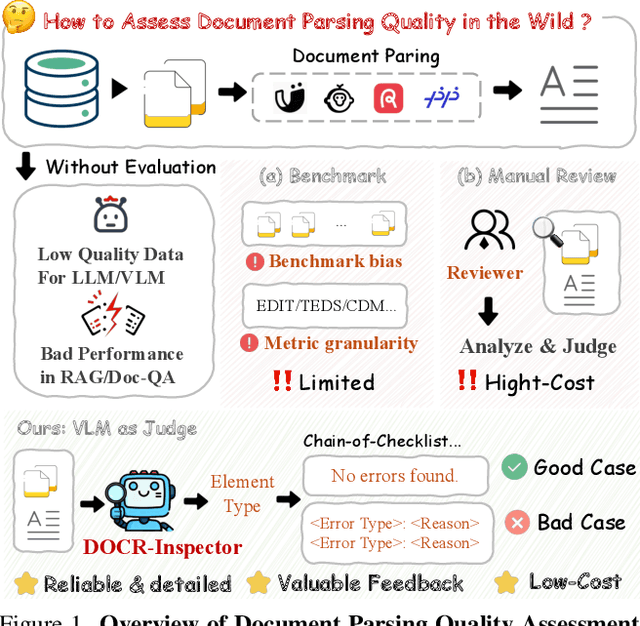
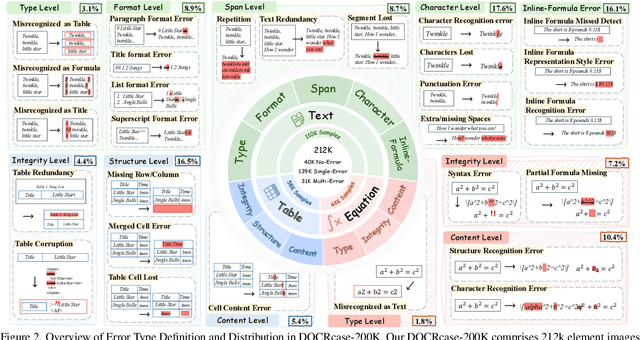
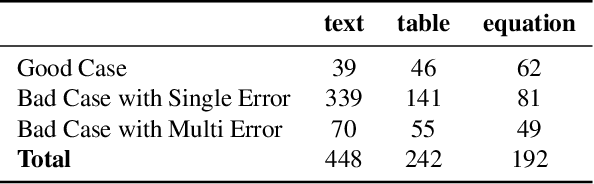
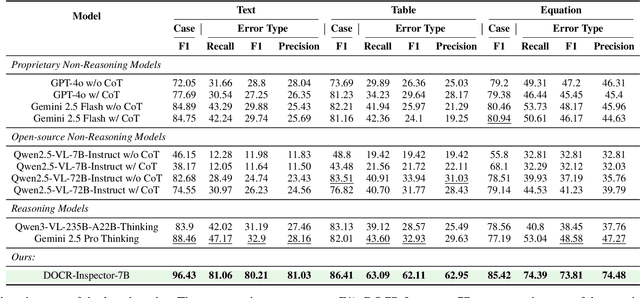
Document parsing aims to transform unstructured PDF images into semi-structured data, facilitating the digitization and utilization of information in diverse domains. While vision language models (VLMs) have significantly advanced this task, achieving reliable, high-quality parsing in real-world scenarios remains challenging. Common practice often selects the top-performing model on standard benchmarks. However, these benchmarks may carry dataset-specific biases, leading to inconsistent model rankings and limited correlation with real-world performance. Moreover, benchmark metrics typically provide only overall scores, which can obscure distinct error patterns in output. This raises a key challenge: how can we reliably and comprehensively assess document parsing quality in the wild? We address this problem with DOCR-Inspector, which formalizes document parsing assessment as fine-grained error detection and analysis. Leveraging VLM-as-a-Judge, DOCR-Inspector analyzes a document image and its parsed output, identifies all errors, assigns them to one of 28 predefined types, and produces a comprehensive quality assessment. To enable this capability, we construct DOCRcase-200K for training and propose the Chain-of-Checklist reasoning paradigm to enable the hierarchical structure of parsing quality assessment. For empirical validation, we introduce DOCRcaseBench, a set of 882 real-world document parsing cases with manual annotations. On this benchmark, DOCR-Inspector-7B outperforms commercial models like Gemini 2.5 Pro, as well as leading open-source models. Further experiments demonstrate that its quality assessments provide valuable guidance for parsing results refinement, making DOCR-Inspector both a practical evaluator and a driver for advancing document parsing systems at scale. Model and code are released at: https://github.com/ZZZZZQT/DOCR-Inspector.
VABench: A Comprehensive Benchmark for Audio-Video Generation
Dec 10, 2025Recent advances in video generation have been remarkable, enabling models to produce visually compelling videos with synchronized audio. While existing video generation benchmarks provide comprehensive metrics for visual quality, they lack convincing evaluations for audio-video generation, especially for models aiming to generate synchronized audio-video outputs. To address this gap, we introduce VABench, a comprehensive and multi-dimensional benchmark framework designed to systematically evaluate the capabilities of synchronous audio-video generation. VABench encompasses three primary task types: text-to-audio-video (T2AV), image-to-audio-video (I2AV), and stereo audio-video generation. It further establishes two major evaluation modules covering 15 dimensions. These dimensions specifically assess pairwise similarities (text-video, text-audio, video-audio), audio-video synchronization, lip-speech consistency, and carefully curated audio and video question-answering (QA) pairs, among others. Furthermore, VABench covers seven major content categories: animals, human sounds, music, environmental sounds, synchronous physical sounds, complex scenes, and virtual worlds. We provide a systematic analysis and visualization of the evaluation results, aiming to establish a new standard for assessing video generation models with synchronous audio capabilities and to promote the comprehensive advancement of the field.
MorphoBench: A Benchmark with Difficulty Adaptive to Model Reasoning
Oct 16, 2025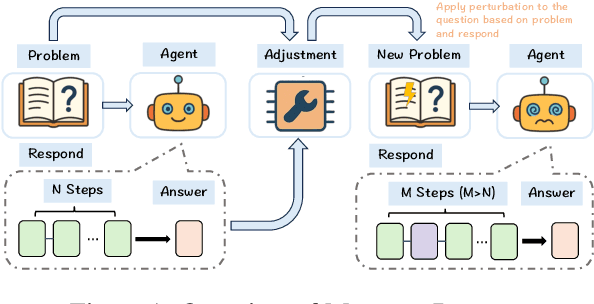

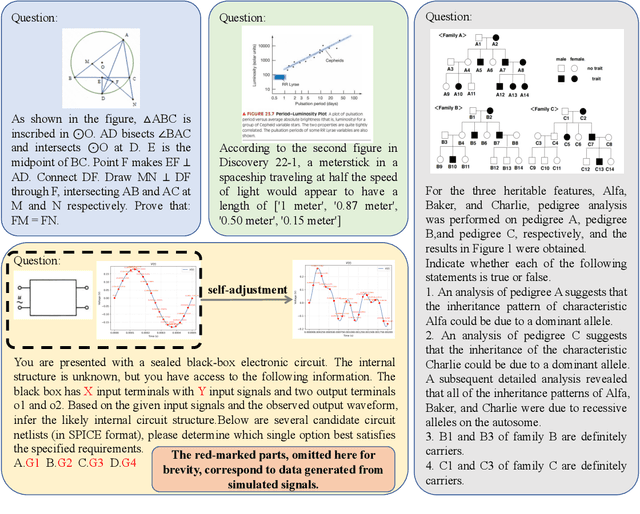
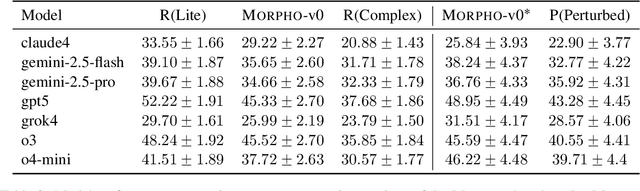
With the advancement of powerful large-scale reasoning models, effectively evaluating the reasoning capabilities of these models has become increasingly important. However, existing benchmarks designed to assess the reasoning abilities of large models tend to be limited in scope and lack the flexibility to adapt their difficulty according to the evolving reasoning capacities of the models. To address this, we propose MorphoBench, a benchmark that incorporates multidisciplinary questions to evaluate the reasoning capabilities of large models and can adjust and update question difficulty based on the reasoning abilities of advanced models. Specifically, we curate the benchmark by selecting and collecting complex reasoning questions from existing benchmarks and sources such as Olympiad-level competitions. Additionally, MorphoBench adaptively modifies the analytical challenge of questions by leveraging key statements generated during the model's reasoning process. Furthermore, it includes questions generated using simulation software, enabling dynamic adjustment of benchmark difficulty with minimal resource consumption. We have gathered over 1,300 test questions and iteratively adjusted the difficulty of MorphoBench based on the reasoning capabilities of models such as o3 and GPT-5. MorphoBench enhances the comprehensiveness and validity of model reasoning evaluation, providing reliable guidance for improving both the reasoning abilities and scientific robustness of large models. The code has been released in https://github.com/OpenDCAI/MorphoBench.